


Who held which role
By the time counsel asks who was involved, the people will have changed roles.

We leave a trail of where we work, what we share, and which version we had. Context-Aware eDiscovery™ follows that trail from identification through review. Legal Data Continuity™ keeps the trail and its obligations intact when the data has to move.

The work at issue in a matter three years from now is being done today. By the time counsel asks who was involved, people will have changed roles, systems will have been migrated or retired, and the business may have been bought or sold.
Cloudficient helps organizations preserve and connect the context needed to understand past events, support future investigations, and meet continuing legal obligations.
By the time counsel asks who was involved, the people will have changed roles.
The work happens across mailboxes, shared repositories, linked files, changing versions, and AI tools.
The systems will have been migrated or retired, and the company may have bought or sold the business where it happened.

Legal Data Continuity protects information through change. Context-Aware eDiscovery makes that information useful when a matter requires it.
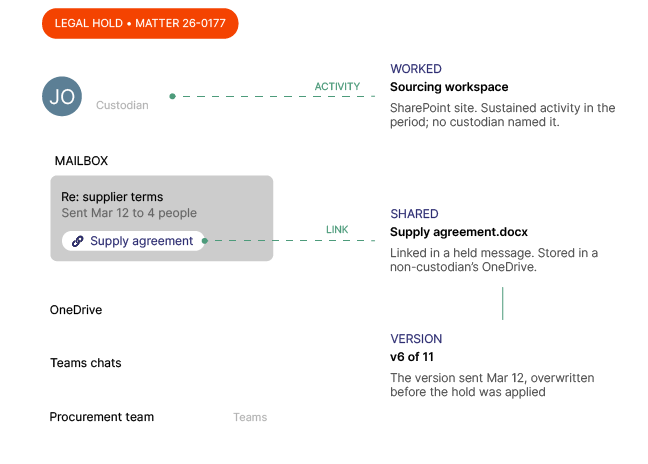
Cloud collaboration creates context around ESI, including who shared it, which version, and from which repository, and that context does not travel with the content into discovery.
Context-Aware eDiscovery carries identity over time, activity and repository context, and document state into the matter, so legal teams can put the right people on hold, collect what was in use, and hand review a corpus with its context attached.
Establishes who held the role when the events occurred, which accounts belong to one person, and which repositories were in use.
Issues and tracks holds, preserves custodial and shared Microsoft 365 sources, and reaches the cloud attachments and versions a custodian-scoped hold does not cover.
Collects against recorded activity rather than repository membership, with conversations, linked files, and versions intact.
Examines the collected population with its context attached, and reduces what moves to review with the reasoning recorded.
Holds, retention requirements, client responsibilities, and regulatory obligations outlive the systems, accounts, and people that produced the data. When the only way to meet one is to keep the old environment running, the obligation has become infrastructure.
Legal Data Continuity gives the obligation and the data it covers an independent home, so the system, the tenant, the account, and the business unit are free to change.
Keeps information protected, searchable, and on hold as long as required, while systems and people change.
Ingests historical, journal, and transition data with the metadata, identity, and relationships future legal work needs.
Classifies live journal feeds and preserved email using models trained on your own examples.
Suspends expiration under legal hold and disposes of eligible data with an explainable audit history.
Whether you are scoping a new matter, retiring a legacy archive, separating data ahead of a divestiture, or handling the files of an attorney who is moving to another firm, we will walk you through how Cloudficient handles it, using your own data.
